I sat down again and played until the position was real. This is that second sitting.
Play better than this loser. Always punish slow development. Be aggressive!
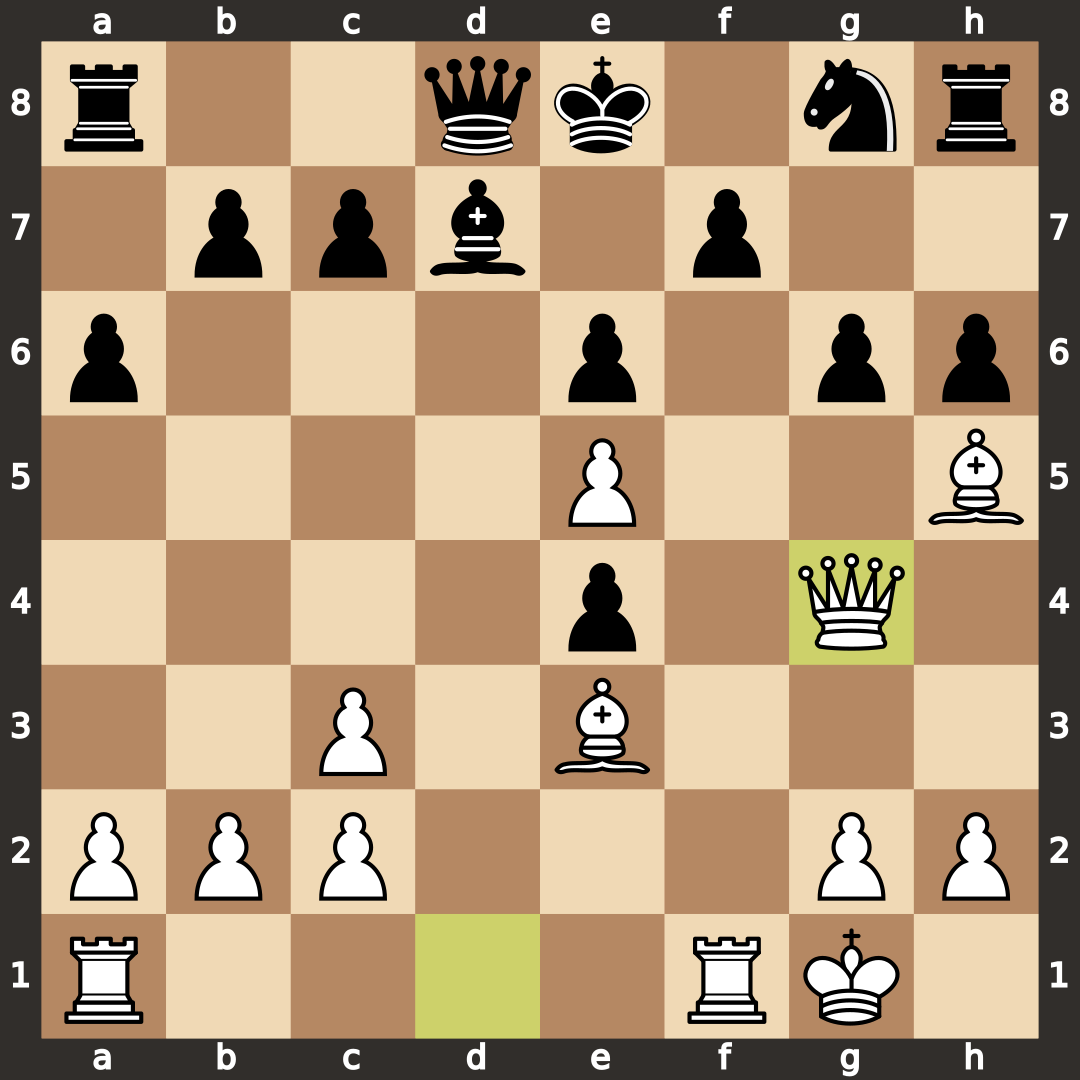
See the key position below after 12. Qg4, featuring an en prise balanced position preceding a critical blunder!
Why can’t Black take the bishop with the g6 pawn? Do you see the follow-up for White?
What is going on with the e4 pawn? Is it a passed pawn? Can it be defended? Should White be concerned with it? What else can Black do if they ignore that minor vulnerability?
If the g6 pawn can’t capture the bishop, does it need more support? How can Black improve the g6 pawn?
The endgame features a bishop pair, forking tactics, and discovered check to secure the mating net, although Black could have made things a bit more difficult.
r2qk1nr/1ppb1p2/p3p1pp/4P2B/4p1Q1/2P1B3/PPP3PP/R4RK1 b kq – 1 12

I wish you the best of luck!!
The Chess Zone — Coffee For Dessert.
Check Coach Chad’s mistakes in the full game.
Full game
Find more moments to study in the full game. Copy the PGN into Lichess → Analysis Board to study on your own.
[Event "Live Chess"]
[Site "Chess.com"]
[Date "2025.07.23"]
[Round "?"]
[White "Guest6086237816"]
[Black "Guest2305453706"]
[Result "1-0"]
[TimeControl "120+1"]
[WhiteElo "1600"]
[BlackElo "1600"]
[Termination "Guest6086237816 won by checkmate"]
[Link "https://www.chess.com/game/141039942414"]
[CFDTicket "CFD-100"]
[SourcePost "6117"]

1. e4 a6 2. f4 h6 3. Be2 Nc6 4. Nc3 e6 5. Nf3 Bb4 6. O-O Bxc3 7. dxc3 d5 8. Be3
dxe4 9. Ne5 Nxe5 10. fxe5 Bd7 11. Bh5 g6 12. Qg4 g5 13. Bxf7+ Ke7 14. Bxg5+
hxg5 15. Qxg5+ Nf6 16. Qxf6+ Kf8 17. Qxh8+ Ke7 18. Qh4+ Kf8 19. Bh5+ Kg8 20.
Qg4+ Kh7 21. Rf7+ Kh8 22. Qg7# 1-0
Leave a Reply